
 de
de
Apps (iPhone, iPad & iPod):
 great white shark
 sharks
 seabirds
Scientific shark articles
Alaska & Wildlife
Arctis
Birds
Cities
Egypt - Land of the Nile
Fauna & Flora Fiji
Fiji sharkproject
Mountains
Nature
Penguins & seals
Polar bear
Sea
Seabirds
Sharks
Underwater
Wildlife South Africa

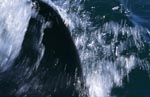
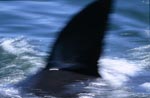
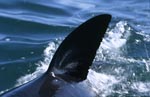
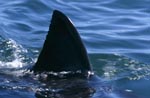
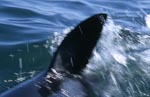
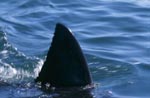
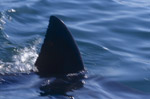
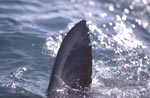
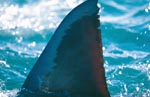
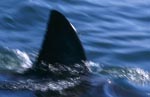
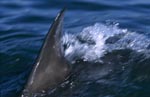
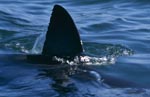
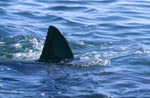
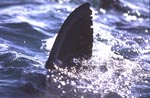
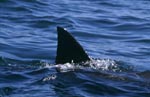
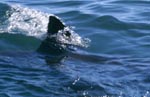
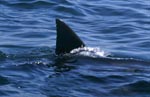
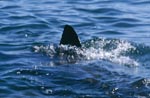
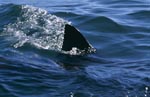
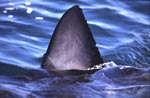
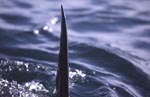
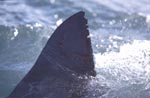
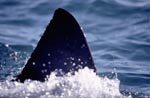
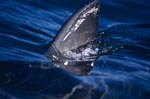
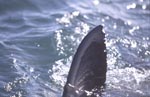
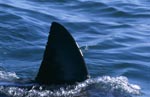
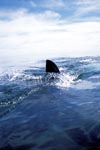
Pictures Great white shark dorsal fins breaking surface near Seal Island, False Bay, Geyser Rock and Dyer Island.
Great White Shark Dorsal FinShortly before sunset we were sailing with our boat close to Seal Island in the False Bay. There is a large seal colony on this island. Some fish bait hangs on a small red buoy, which is held into the water from the boat. A great white shark has followed the trail of the scent and has reached our boat. The dorsal fin can be seen quite distinctively. It is an individual, special feature of recognition of the shark, unique and unmistakable.
Following the article, which appeared in the edition of „Wissenschaft� on 20th August, 2004, US biomechanics have deciphered the use of the rakish shape of the shark fin. The dorsal fin and also the tail fin with its asymmetric composition ensure the mobility of the shark. The researchers analysed the swirls of current (high-speed camera), created in an upward motion by the enlarged fin. “The current conducts the water simultaneously backwards and downwards�, as explained by Cheryl Wilga and George Lauder from the Rhode Island University. “In this way the vertical manoeuvrablility is increased.“
With fishes with symmetrical fins, swirls of current are formed around a rotational axis, however the shark allows the water to flow in a more complicated way. Two swirl centres layered above each other stabilise it with sideways (or lateral) and vertical movements (Wissenschaft 20/08/2004).
Biological Profile
Carcharodon carcharias
IUCN Red List of Threatened Species
| page 1 of 2 | page 2 -> |

|

|

| page 1 of 2 | page 2 -> |